van·a·bond [van-uh-bond]
noun
1. a budget traveler of the extreme variety.
2. a specialist in creative vehicle conversions, spontaneous road trips, and serendipitous meetings.
3. a wandering seeker of friendship, adventure, and art.
van·a·bond [van-uh-bond]
noun
1. a budget traveler of the extreme variety.
2. a specialist in creative vehicle conversions, spontaneous road trips, and serendipitous meetings.
3. a wandering seeker of friendship, adventure, and art.
The tale of my Moroccan wine scene hi-jinx will be included in this upcoming anthology. My only complaint is that they didn’t put my name next to Tim Cahill’s on the cover. I’m sure he’s disappointed, too. http://www.amazon.com/The-Irresponsible-Traveller-Scrapes-Escapes/dp/1841625620

 When my grandmother passed, she left me a silver tea service, a flight of crystal glasses, and a set of fine china. Preserved in her display cabinet and brought out twice a year for Christmas and Thanksgiving, they were curated with the greatest care. Now they were in boxes on my kitchen floor. How this fragile-boned finery would ever fit into my rough-and-tumble lifestyle was a mystery.
I unpacked each item from its bubble wrap and parchment and placed them on my counter. Unmarried, unconventional—a “free spirit,”– I simply didn’t host the kind of Special Occasions that warranted gilded saucers, delicate sorbet cups, and stainless pitchers. Or to rephrase that: nearly every evening felt like a special occasion—my house a procession of spontaneous music jams, impromptu dinners, and travelers. But the bunch I consorted with were unwieldy, folks-on-the-fly and wild spirits–a charismatic set to be sure– not the refined raised-pinky chit-chatters my grandmother kept stead company with.
And so as I arranged each of my grandmother’s plates and crystal goblets along the kitchen shelves of my ramshackle cottage, a dissonance set in. In the commingling of our kitchenware, I could see our mismatched personalities: Her silver spoons clashed with my tin blue camping plates, my sturdy masons sidled strangely with her delicate sorbets, and her thin-as-air wine glasses stood in contrast to my hand-spun coffee mugs all crazily Pollock-ed with glaze. In then end, dinner at my table would be a curious remix of era and lifestyle–‘Hillbilly chic’ I dubbed it, and proceeded to use her wares with confidence: If I knew if I didn’t use them now, I would never use them.
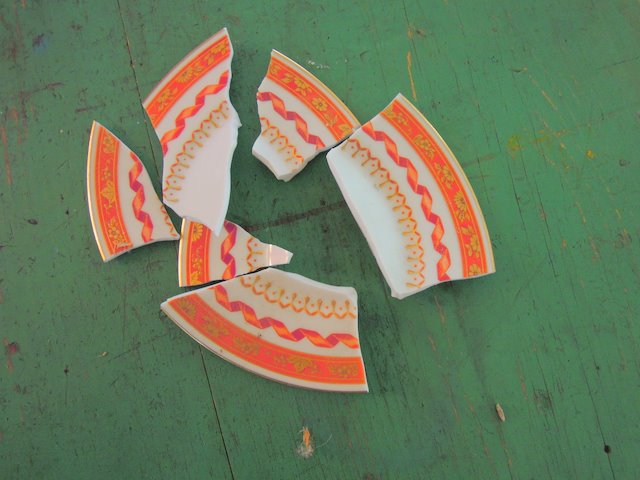
But it was a risk, I learned quickly, as one by one the glasses began to break—a crystal goblet upturned by Jeanine’s elbow in an animated Scrabble game, another sat on by Ron during an after-dark BBQ. A few plates fell off the shelf one midnight—a ghost perhaps?–and another was sent flying when a bulldog dashed under the table. Once, mowing the lawn, I discovered a silver spoon that a guest inadvertently dropped while bringing their plate in from a midday picnic.
I have felt guilty at times: when in the middle of a music jam I fell in love with the chiming resonance of spoon-on-crystal-glass and was suddenly ashamed: What would my grandmother make of this? I remembered their precious placement along the dust-free shelves of her china cabinet, but then resumed my heirloom percussion: It may have been irreverent, I told myself, but I was certainly enjoying them more than my grandmother ever did.
But it was one guest in particular that settled my conscience on it finally. Thomas and his wife Mary showed up from Sonoma with guitars and a large musical repertoire. We ate dinner and sang Bob Dylan and as the porcelain plate of the moon rose over the mountain, I sipped Merlot from a goblet and told him of my conflict about using my family heirlooms so casually.
Thomas replied with a story about the Oakland fires back in 1991–a disaster that left almost 4,000 homes destroyed in its wake. A memorial wall now stands as a reminder of the temporality of life and of material goods and as an encouragement not to put things off: Use your fine china, it instructs.
Two weeks later Thomas died unexpectedly, making this story now indelible in my mind.
I continue to use my grandmother’s dishes, but am trying to be more careful. My devil-may-care attitude is being replaced with something more gingerly: I’m newly aware that each one is as irreplaceable as Thomas who filled the warm air with music on that singular summer night. Every broken dish is a small stab, a piece of my grandmother, of my family history gone. At the shatter-sound of each loss, I let a sharp breath out and take the lesson: Let-it-go. I know it is inevitable: that someday they will all be gone if not in my generation, than the next or the next.
 Sell your cleverness, buy bewilderment -Rumi
Ann breezed into the café at Rue Foumelle for our 4:00 consultation. She unbuttoned her overcoat, straightened her scarf, and sat. She carried the smell of crisp autumn leaves.
I got in my teacher-frame-of-mind, always slightly astonished to find myself in this position—as The Teacher–especially so with someone like Ann, who is a couple of decades older than me, who has trained airline pilots, and has a poise and an aura of kindness I aspire too. So often while Ann studied writing, I studied Ann.
What was it? Her perfectly tied scarf? Her posture? Her easy but sagely eye contact? She wasn’t blustery and loud. She didn’t dominate dinner tables, or command attention. Whatever it was, it couldn’t be mimicked. It was a presence. A subtle gravity that drew your attention like a whisper. Something earned.
We ordered hibiscus tea and I spread out my notes and got started. Ann lost her daughter to cancer several years ago and her essay was about a healing retreat on an island with her spiritual teacher. I wanted to impose order and flow on the first draft of her story.
I think it best if you reveal one spiritual lesson per section. I numbered each statement of revelation and circled the relevant text.
It was odd to reduce her enormous experience of grief into these perfunctory writing tips. But I was no psychologist and though I’ve had my share of losses—I trusted completely people who said that losing a child is that worst thing a person could go through. I wondered: What did I have to offer Ann, who had endured so much more? All I had were these tools of expression—the mechanics of sentence and sentiment. So, I continued.
And also, break down broad statements into smaller details.
This was key. First drafts are often fraught with words that bulge like overstuffed suitcase: Anger. Beauty. Happy. These words are too big and general.
Vivid writing is a trick of proportions. The writer has to get tiny and specific in order to communicate what is large and universal. As the saying goes, “God is in the details.”
And so rather than say “the man was handsome,” show us the arch of his brow, the low lilt of his voice. Don’t tell us you were fed up with urban living. Show us you hucking your iPhone at the IKEA lamp across the room while a loud delivery truck idled nonstop outside the window.
I circled the big general words in Ann’s essay and prescribed breaking them down into small specific images.
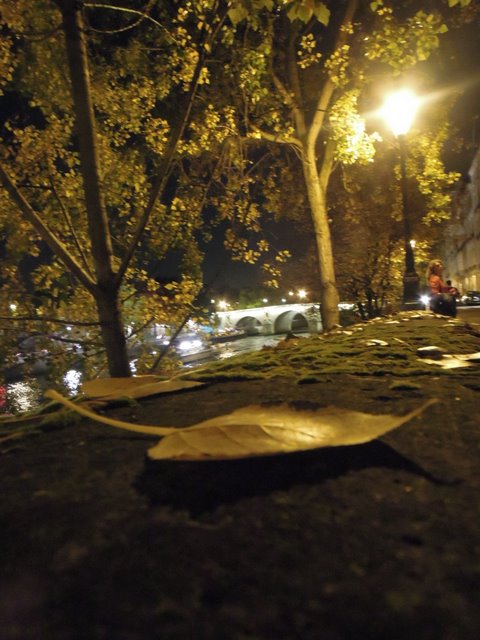
I buttoned my coat and stepped back out into the near-winter air. I crossed the bistro-lined rue and followed it over the choppy Seine toward Notre Dame. I’d passed the famed cathedral dozens of times, awed as anyone by the flying buttresses which, depending on the light, looked by turns beautiful or sinister. But I never did felt a particular need to go in, always too put off by the crowd outside the entrance.
But in that evening’s dimming light, there was an unusual sense of spaciousness outside, and an easy flow of people going through the front door which pulled at me like a brisk current. I left the hint-of-winter air and yielded. The atmosphere was full of hymns and incense. Mass was in session.
In just a few steps, I felt the sudden awe of taking that last step onto a mountain peak. Not a particularly religious sensation –in fact, it felt much bigger than religion. It was a rapping in the epicenter in my chest, a place sometimes stirred awake by poetry, or music: a grandeur that jars me and makes me realize that, in fact, I spend most of my waking life asleep.
I was happy to be there on my own with no brilliant and hilarious friend at my side to share whispering snarky invectives against religion, or running commentaries on the gothic architecture. Cathedrals, I realized, are best experienced alone.
I proceeded around the perimeter of the cathedral, past vignettes, past alcoves, past the transect, under the arches, past people lighting candles, people kneeled in prayer, people gazing up and felt myself in the presence of something very, very old and felt dwarfed not just by the cavernous arches, but by time, too—by the old incantations, mysterious, inscrutable, perennial, and hallowed, reaching through the ages to me right there in my tennis shoes.
In that resounding space, I felt myself a small detail, tiny but telling. This sense of proportion came to me as a relief–a break from the daily grind of trying to be Somebody. Like a specific piece of grass in a large field, I was a working part of a larger order, and humbled by a huge mystery.
I was small on the outside but big on the inside–right in the place where good writing comes from.
I completed my wander around the cathedral and in one step entered again the small mind of the street. My big hallowed self started dozing off to sleep, and soon I was smoothing my hair in a shop window and craving a glass of house red.
I thought of Ann’s grief, the size of it, and how it must constantly alter her own sense of scale. I thought of her calm presence which wasn’t I realized out of timidity or shyness, but sourced from an inner life as big as Notre Dame.
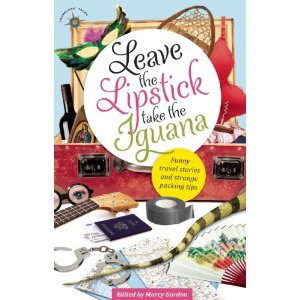 (my story as it appears in the recently released collection Leave the Lipstick, Take the Iguana: Funny Travel Stories & Strange Packing Tips)
When my mother turned 50, we decided it was time she traveled. Aside from a few quick trips over the Mexican border, she’d never left the United States. She wanted to go some place clean–but lively, cultural–but not overly foreign. We decided on Italy.
Only one thing worried her. Watch out for the men, a few people warned. They are aggressive, will grope you, and make lewd comments—ESPECIALLY since you are blondes. Italian men love blondes.
At 50, my mom was a quite good-looking and walking down the street together we accrued roughly about the same amount of male attention. She had a nice figure, beautiful face, and stylish clothes. I was less kept, but at 24 had sea-white hair the flowed all the way down to my waist.
We brainstormed. What could we do to fend off the unwanted advances? Tying up our hair or hiding it beneath a hat was an option, but seemed too oppressive. So instead, we prepared what we would say in response and honed our snide looks. If an Italian man approached us with a dramatic proclamation of love, we knew exactly what we’d say:
I like your approach, now let’s see your departure
Or were he to say something like I know how to please a woman, we would say Then please leave us alone.
And reserved for the lewdest offenders: Sorry, we don’t date outside our species.
Mom decided that instead of hotels, we would stay in the convents with the Holy Sisters—far, far away from the machismo of Italy’s streets. We would be fine.
Should we bring pepper spray? My mother fretted. I laughed, but she was serious.
We started our tour of Italy in Venice, riding gondolas down the waterways and wandering the cobblestone streets. We were so awed by the beauty of the city that we forgot all about the perils of Italian men. We were too busy dining on pasta e fasioi , drinking the house wine, and blowing cigarette smoke over our shoulders to notice them. We spent a morning loitering in the Piazza San Marco where I fed what seemed like a thousand pigeons. One late afternoon, we strolled under the quintessential lines of clean laundry fluttering in the breeze.
Florence was next and we loved the bridges, walking the length of Ponte Vecchio back and forth a dozen times. We toured Galleria dell’ Academia, eyeing the perfection of Michelangelo’s David, and almost blushing at his beauty. So far, all was going well. Days had gone by, and not a single Italian man had leered. We hadn’t even heard a Ciao bella! Mom began to relax.
Days peeled away in Lucca next. Each morning we rented bicycles and rode around the wall surrounding the town. We spent days drinking cappuccinos and looking at clothing and ceramics. On Mom’s birthday, I decorated her bike in crepe paper and loaded the basket with cakes and presents. We rode around the wall, parked our bikes, and celebrated at a picnic table.
Happy 50th Mom, I said, lighting the candles.
On the way to Rome we put our guards back up. Rome would be the surely be the epicenter of unwanted catcalls and intrusive groping. We set stern expressions, ready to admonish any Georgio or Afonso who got out of line.
Once in the city, we boarded a packed bus to the Sistine Chapel. Watch it, mom said as we squeezed in and stood pelvis-to-pelvis with a crowd of Italian men. We exchanged worried glances the whole ride, but once again nothing happened. As we entered the chapel, I became aware of a gnawing question, Where were all the aggressive Italian men? I wondered.
Not ten minutes later, a young Italian man in glasses and too-short pants approached us with a look of faint desire. Mom braced. Finally, I sighed. He addressed my mother with the utmost politeness, a pure gentleman: Your daughter is beautiful. Can I ask your permission to take her on a date?
A few days later, we boarded a train to Milan where we’d catch our flight back to the U.S. As the train coursed northward, Mom inched closer to the conductor, tossed her hair a few times and by the time the train pulled into Milan, had secured us a date. He has a friend, she whispered. We followed him off the train, and he led us to the employee cafeteria where his friend, a 50-something named Giovanni, waited. We split a bag of chips four ways.
My mother and I left Italy deeply offended. All that worry and preparation and not a single catcall. and We never got to use the lines we’d rehearsed so studiously.
Years have passed since our trip to Italy, and on some level I still haven’t forgotten the wounding indifference of Italy’s men. But recently, I’ve been spending my mornings in a café in Sausalito. The place is frequented by Italians and each morning as I pass the sidewalk tables I hear a chorus of Ciao Bella, and Beautiful Smile. When I rise to the cream counter carrying my coffee, the men glance up from their newspapers, and my ego swells like a popover. It’s as if all the ogling men that were supposed to be in Italy had gathered in this small Sausalito café.
One morning, I was standing at the register paying for my espresso. An older Italian man was at a table behind me, his eyes about level with my buttocks.
Ciao Bella, he said. I braced and returned a stiff Hi.
How are you? he asked.
Fine. You?
His watery eyes leered at the back of my jeans.
Well . . . I love this point of view he answered.
I felt heat rise under my shirt. How inappropriate I gasped. How politically incorrect. Where was this guy in Italy, I wondered, when I was prepared, guarded, and equipped. Now, standing there at the counter, I couldn’t remember a single one of the comebacks my mom and I had prepared. So, I turned and said the first thing that came to mind:
Thanks.
For more stories, buy the book here: Leave the Lipstick, Take the Iguana: Funny Travel Stories & Strange Packing Tips
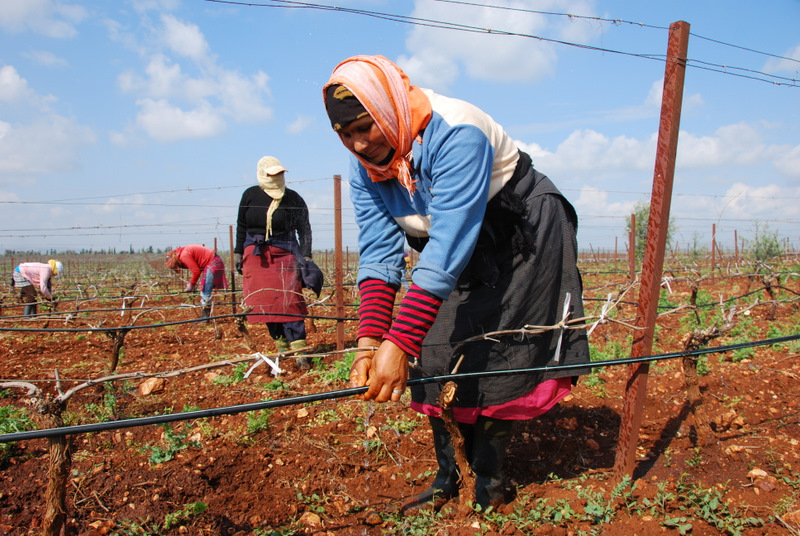 My article in The San Francisco Chronicle today. Click here
 I will be co-teaching the Deep Travel Workshop at the legendary bookstore Shakespeare & Company in Paris on October 23, 24 and 26. Come share your passion for writing with us at the S&C bookstore and in the cafes along the Seine!
More Info: Deep Travel is a three-session workshop in which we venture vertically into the deepest strata of our travel experience. Our goal is to take our writing past mere “travelogue” to capture moments of transformation, and evoke the sensation we often have at the end of our journeys that we are changed.
Join award-winning writers Christina Ammon and Erin Byrne, as we forge connections between our personal journeys—and the political, cultural, and mythical contexts in which they unfold.
Contact me at: flyinghobogirl@gmail.com
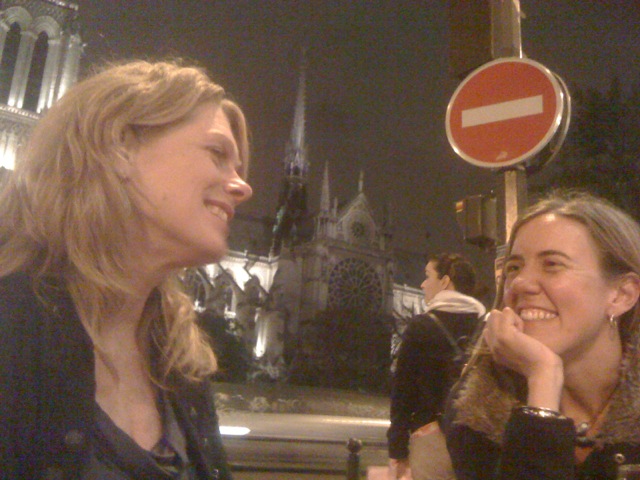
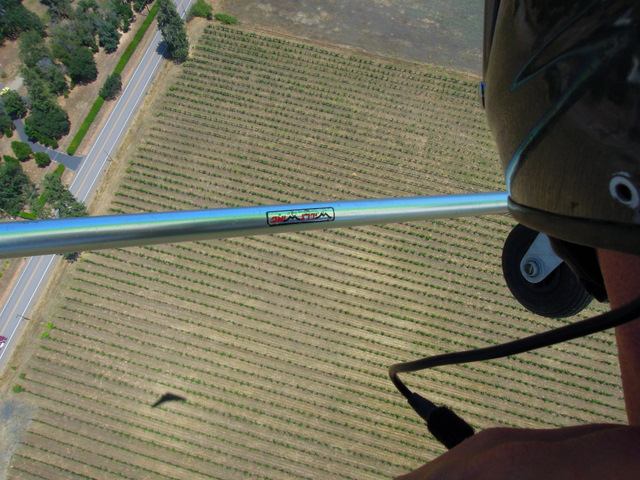
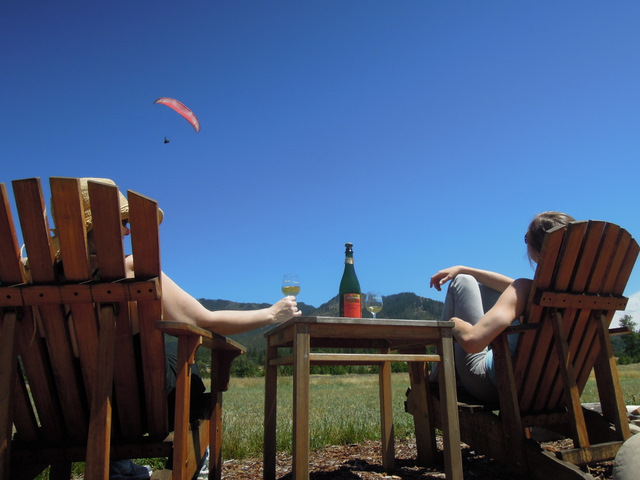 My Oregonian article about Flights of Wine in southern Oregon’s Applegate Valley. This place is paradise! To read, click here
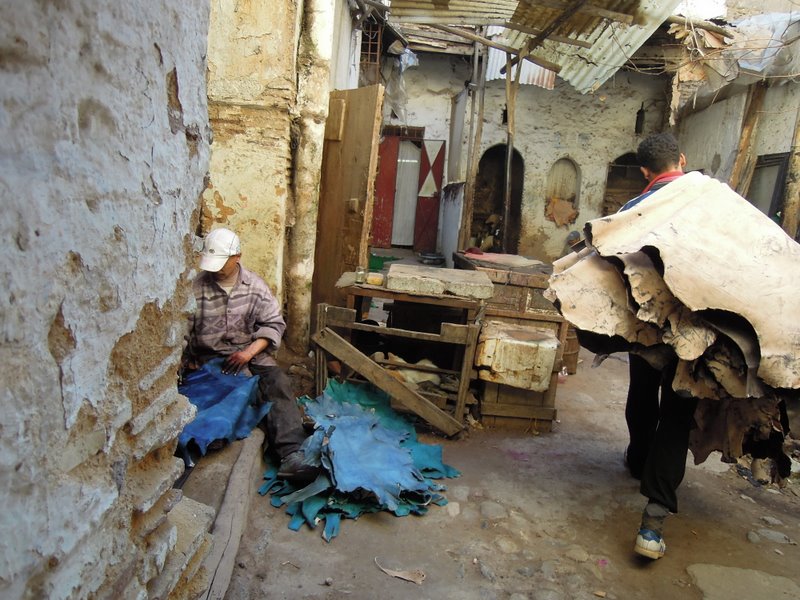 My Oregonian article in Sunday’s travel section. The tricky business of restoring the Fez Medina here:

My entry about the Chinese concept of Yuan Fen in AlterNet today. http://www.alternet.org/culture/155948/comments/