George Rede kindly interviewed me about travel-blogging for The Oregonian: http://www.oregonlive.com/news-network/index.ssf/2012/04/featured_blog_partner_qa_with_11.html
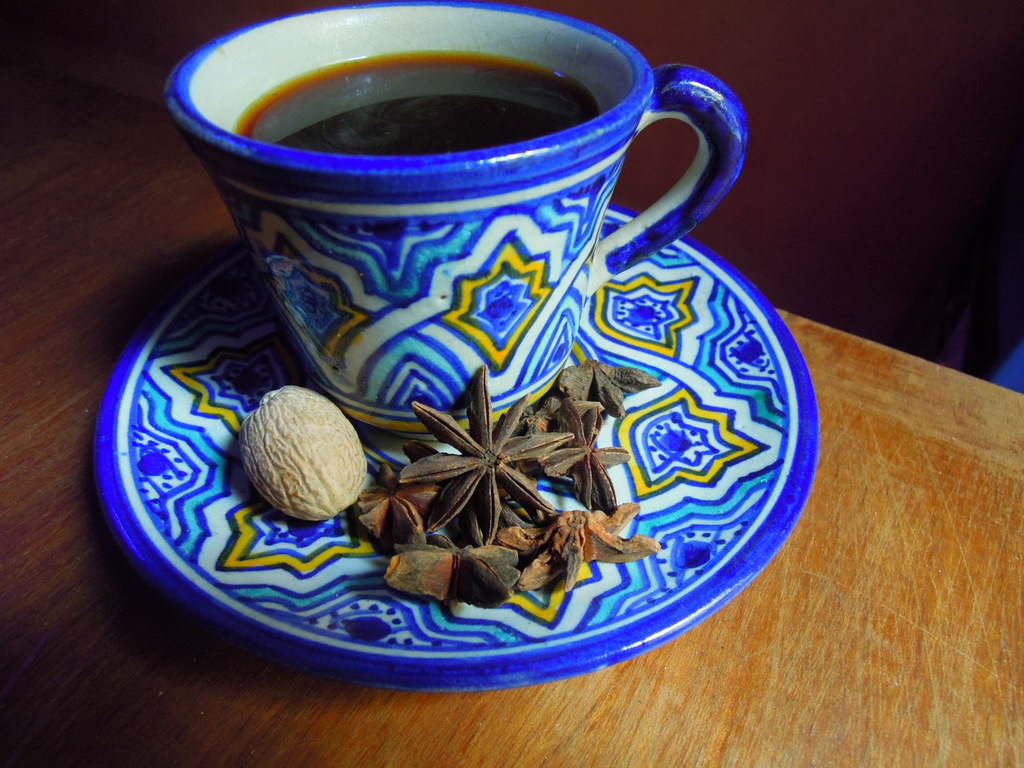
Medina Buzz: Moroccan spiced coffee
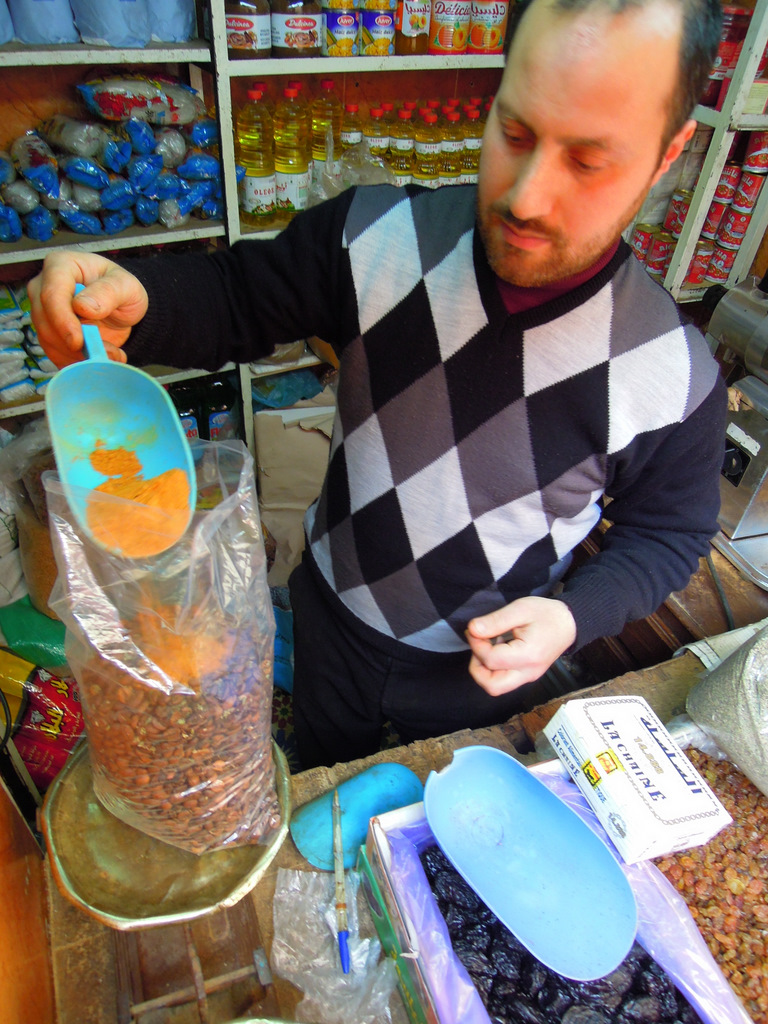
It would be easy to pass over Youssef Bouhlal’s tiny shop in the Fez Medina. Its modest offerings of dried lentils, white beans, garbanzos, oil, and milk are unremarkable among the competing sights of souk. But like the plain facades that cloak the ornate interiors of the Medina’s mosques and medrassas, the splendor of Bouhlal’s shop is hidden. I wouldn’t have known about it without my expat friend, Sandy McCutcheon, who introduced me to Bouhlal’s shop on one of our Medina strolls.
“This is the best place to buy coffee in the Medina,” he said, placing his order for a half-kilo.
Boudlal, 37, upended a bag of Arabica coffee beans into a grinder and then sprinkled on an array of simple, but unexpected, spices: a pinch of sesame seeds, a whole nutmeg, a few peppercorn…
When the grinder switched off, Bouhlal held out a scoop of the coffee for us to smell. Inhaling the rich aromatic spices invoked cozy memories winter mornings, Indian chai, and holiday treats.
Although Fez is full of sidewalk cafes serving espresso drinks, spiced coffee is rarely on the menu. Moroccans mostly prepare it in the home. You can buy bags at several places in the Medina, but Bouhlal’s blend stands out both for its well-balanced flavor and its low price: just six Euros will buy you a kilo. And while blending your order, Boudlal also can converse about English literature. He’s studied the works of James Joyce, Joseph Conrad, and Herman Melville.
His coffee is as well-traveled as his mind. Guests to Bouhlal’s shop invariably buy a stash to take home. “My coffee has traveled all over the world,” Bouhlal said, twirling a bag of sesame seeds closed.
I wondered: Perhaps there is an international market for Bouhlal’s unique blend? “This could be the headquarters,” I declared, eyeing his small stall with big visions. “But we would need a larger grinder.”
Insha’Allah,” he laughed.
Bouhlal’s small shop is located in the R’Cif souk in the Fez Medina. If you can’t make it all the way to Fez, you can experiment with your own blend at home. Bouhlal does not measure by instruments, but by intuition. Here is what I saw him add:
Seasame seeds
Black Pepper
Whole nutmeg
Cinnamon
Anise Seed
Ginger
Combine these spices with quality coffee beans and grind. Brew in a stovetop espresso maker or percolator of your choice. Cream and sugar transform this spicy delight into a dessert. Prepare to be addicted.
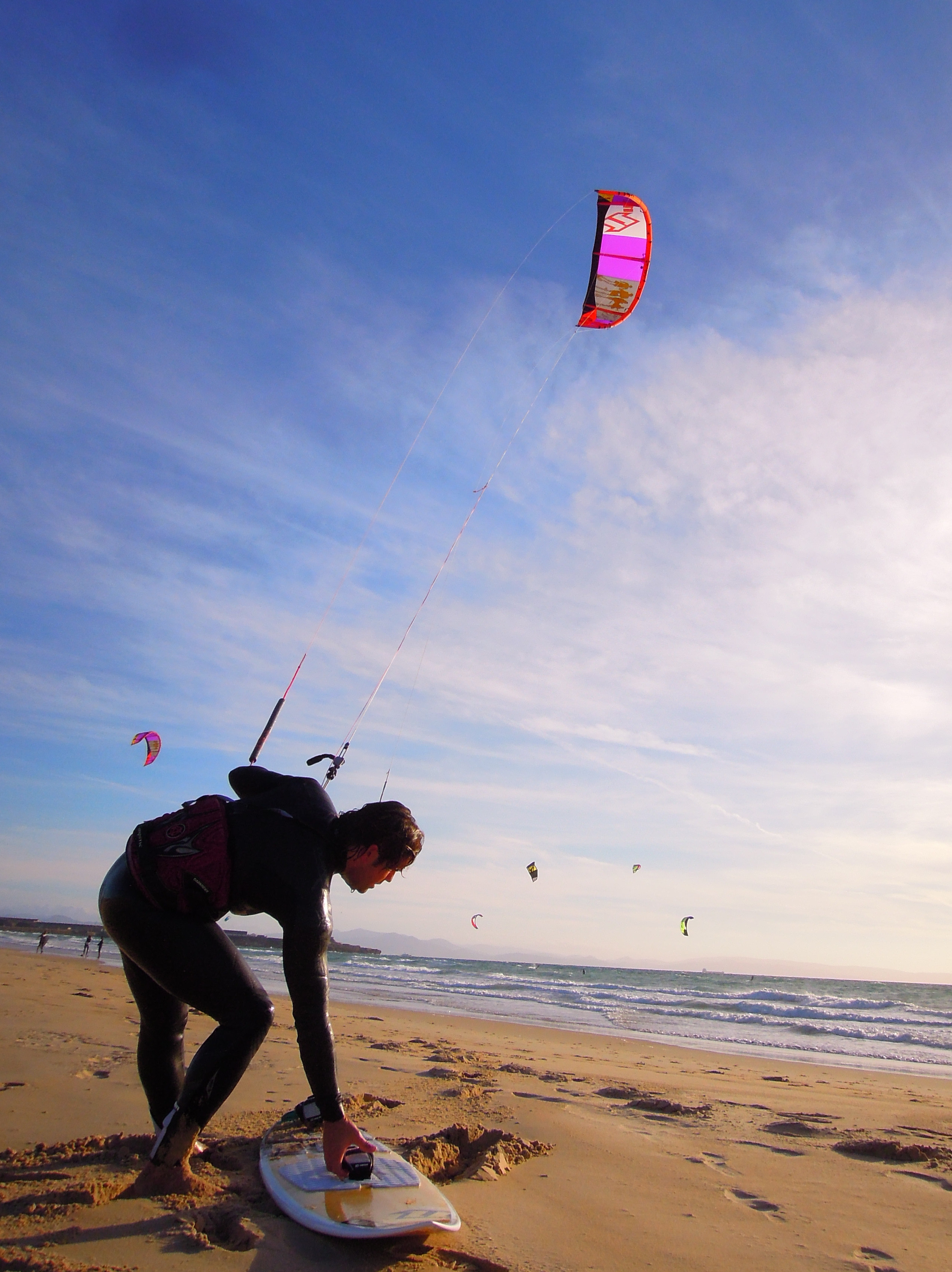
In Tarifa without a kiteboard ….
Rounding the bend into Tarifa, I had to revise my expectations. I’d presumed the beach town, located at the southernmost point of Spain, was a winter-escape from northern Europe. My bikini and SPF waited at the top of my bag, and I was ready to toast the sunshine with a mojito.
But as a gale force wind tried to shove my camper off the road, it was clear: this town was no simple-minded Margaritaville …
For the rest of the story, go to: The Oregonian Travel Section
Over-priced Carpets and Priceless Wisdom
Abdul gestured to heaven.
I used to work for money. Now I work for Allah. We are sitting outside his ceramic shop in one of those rare beams of sun that filter into the Fez medina at midday. Just a moment ago, he was laying on a heavy sales pitch for a tagine; now he was praising Allah.
This was not like shopping in America. The sales clerks at Victoria’s Secret or The Gap are more interested in pushing a three-for-the-price-of-two panties, –or selling their credit line–than sitting in a ray of sun talking God.
But to be clear: Abdul did have a keen interest in selling his wares. Anyone who has spent a split second in the medina knows that the shopkeepers are relentless. They call out to you everywhere you walk, and sometimes trailing you down the street.
But what is redeeming about medina is that although overpriced gadgets may be plentiful, so are spiritual truths. The salesmen of the medina are shape-shifters. One minute Yousef-Carpet Salesman is tricking you into his shop and the next, he is waxing on like Khalil Gibran.
“One day sunny, one day raining. One day good, the next day bad.” Si Mohamud was standing amidst the antique vases of his furniture shop. “That your heart is beating, this is important.” He placed his hand on his chest. “Health. It is the only thing that matters.”
Somehow the shopkeepers of the Fez medina aren’t aware of the dirty secret of all thriving capitalist societies: that happy people don’t buy things. Dissatisfaction–not gratitude—is what fuels consumerism. Tell them they are not thin enough, blonde enough, or young enough and their wallets will turn inside out. And lose the Insha-Allah, that laissez-faire sentiment that turns our fate over to the Higher Power. Tell them that with the right pair of skinny jeans, they can be the master of the universe
“Enjoy every second. For you do not know when and where you will die,” Rashid counseled as I leaned toward the mirror to inspect a pair of silver earrings and formulated my bid. My heart leapt. He’s right! I plucked the earrings from my lobes. What am I doing spending money in this dark shop I should be out on the sunny rooftop, watching migrating storks and the springtime hills.
It’s not just wise words that you find in the medina, but also wise postures. Old men in djallaba lean all day against weather-stained walls, content as horses turned out to pasture. They occupy sidewalk tables, taking in the scene over cups of mint tea that never seem to empty. On my way home each day, I pass the same plumber taking the same seat of repose in the same chair. Such postures don’t exist in America. There, time is money, and everyone must fiddle with their cell phones, be eating, or be on their way somewhere. In the contented body-language of the Fassi lies a sort of somatic advertisement for Simply Being.
No shopping trip is perfunctory in the labyrinthine byways of the medina. The sacred and the profane mix like intimate aromas and aggressive sales pitches are in no way at odds with spiritual pursuits. False guides bamboozle you into tannery tours en-route to the mosque. Carpet sellers sing Hamdulla! and then rob you blind. The wisdom of the ages echo off walls hung with overpriced kitsch. You set off scouting for a roll of toilet paper, and suddenly find yourself standing in the center Si-Mohammed’s antique shop, spellbound by his wisdom, and giving thanks for the very beating of your heart.
For more stories from Fez, visit The View from Fez
Les Descendeurs (by Andy Pag)
We all relied on tips to make our jobs as tour guides worthwhile. My then girlfriend called me disgusted to tell me about an American passenger that hadn’t coughed up in the usual way. Instead of the recommended $3/day this septuagenarian had given her some chocolate and a pair of nylon tights.
It seems the oldtimer had been to Italy once before, as a GI in the 1940s. In those days a Hershey bar, stick of gum, and a pair of stockings curried a lot of favour with Italian girls. Now in his 70s he’d had the forethought to pack some American treats with him when he’d left Iowa, presumably with the intention of rekindling those good times.
My ex didn’t know whether to be more annoyed over the $50 tip she’d lost out on, or the thought that this dirty old man had lecherous designs on her which he thought some cheap leggings would pay for.
Getting back into the truck as the ferry pulled into Tangier I noticed the Mercedes 609 with the German number plates parked next to me. A red faced ruddy man at the wheel. A Descendeur for sure.
“Where are you going with your truck?” I asked.
“Gambia.” He announced proudly, anticipating the usual flicker of amazement that people always give when you announce you are driving deep into Africa.
I declared my credentials. “You stay at Camping Sukuta?” It was the place where all the Germans stayed, despite the owner’s money grubbing best friend that pulled all manner of tricks to get you to sell him your car for a knock-down price. “Say hi to Wolfgang from me, just watch your wallet when he’s around.” His cheeks perked even redder.
In the time it took for the car deck doors to open we chatted about characters along the way, the route through Senegal, the contents of his van, and what a 609 is worth in Gambia these days. I didn’t understand much of what he said, my German is terrible, and he made no effort to simplify his replies.
He glowed with a confident expression I recognised from my time as a Descendeur (Literally “The taker-downers”, it’s French slang for someone who takes cars down to sell in West Africa) and as a tour guide, bordering on smugness, proud to be travelling and making money while he did it. Maybe it was just the glow of the cheap Lidl beers his boozy breath betrayed.
Five thousand Euros his truck would be worth he shrugged with false modesty. In the back, one and a half tonnes of batteries for plant equipment, along with the usual assortment of generators, pumps, spare parts and household electronics, which could be traded for fuel and repairs along the journey.
“And the Moroccan customs?” I asked, weary from my experience when three of us tried to bring in two lorries, four cars, a van, a couple of motorbikes, a Mercedes engine, six radiators, 2 tonnes of biodiesel, and 11 truck tires but got stuck here for a week narrowly avoiding having the lot impounded.
“Alle sind mein Freund” Everyone is my friend. He winked as he rubbed his fingers together feeling imaginary cash.
The mêlée of Customs formalities endures. Arm waving, paperwork, and waiting. While I tried to stand my ground in order of arrivals, I spotted a couple of cars with French plates and Senegalese drivers. In all my years (eight) as a Descendeur I only ever saw one African Descendeur. He was Senegalese too and explained that to combat the overt racism of the Moroccan police he wore a blue velvet jacket and polished shoes.
The ditsy South Carolina belle I was reluctantly guiding pointed him out to me as he spoke with a trio of Belgian men and asked disconcertedly, “Are those Belgians sharing their car with their butler?” It was just one of countless idiotic things she said that eventually prompted me to quit.
The last straw came when she insisted I ask the priest of the church we were in who a statue of a woman holding a baby depicted. She wasn’t convinced when I told her it was the Virgin Mary, and the understandably priest just stared back at me trying to figure out if I was an idiot or a heathen.
Sharing the dumb things clients said kept me and my ex sane. There was the time someone reminded her that Napoleon and Michelangelo were brothers. The difference between Bonaparte and Buonaroti, as well as the small matter of a few hundred years presumably not being so critical in the “olden days”. Another insisted that they had removed the lower third of the Eiffel tower since her previous visit to Paris. But my favourite was the regular request to point out kangaroos when we crossed into Austria.
The Senegalese guys in Tangier were both driving Peugeot 405s. In my days it was 504s. Times change. The Moroccans seemed pretty fair to them, and they were the first out of the gates. They had friends at the Senegalese border post of Diama, who would squirrel their cars in avoiding the fees that the German would have to pay.
My turn eventually came and the forms were filled out, rubber stamped, and after a cursory search I was shown the gate too.
Meanwhile the 609 had been pulled off to the side. While in the past you could rely on the laziness of the customs not to search too deeply in overloaded vehicles, they now unveiled a mobile X-ray truck. Those contraband batteries would show up like gleaming beacons. The Moroccans had come a long way since my Descendeur days and all that Gambian-bound hardware was about to be confiscated 3000km short of its destination.
I glimpsed the German as I pulled out offering up something from his truck to avoid being exposed by the X-rays. I couldn’t see for sure but it might have been a Hershey bar, or a pair of nylons.
The View from Fez
This great Lonely Planet featured blog published a great entry about the Biotruck …
http://riadzany.blogspot.com/2012/02/global-eco-adventurers-arrive-in-fez.html
Subjectification
I’d been in Fez two days when Uri, a gal from my hostel, unfolded a map on the breakfast table and invited me to join her tour group for the day. I balked.
I don’t like formal tours—the sight-seeing, tight schedules, and gift shops leave me feeling flat. Plus, I had my stereotypes: Uri was from Thailand and her friends were from Indonesia and Korea. In my experience, Asian tour groups spend a lot of time taking snaps. And they probably had jobs in tech and would want to talk computers.
But by the time we finished our eggs and coffee, I was convinced. If we pooled our money, the tour would be cheap. Plus, the last couple days in the medina left me feeling like a walking wallet. Grouping up afforded protection from the aggressive street touts in the way that schooling protects fish from sharks. It’d be easier to get around.
Our first stop was a museum. Uri and I walked down a freezing cold hallway lined with glass-encased heirlooms: an old sundial, some rusty earrings, tattered rugs. But both of us were more interested in the living than the dead inert objects of the past. We found our way outside again.
We strolled between rows of mint and orange trees, and talked about Thailand. I was there last year. My recollections were largely culinary: the crunchy streetcart Tom Sum, the ubiquitous phad Thai, the milky-sweet iced-teas that were my afternoon ritual. And, of course, it’s impossible to not remember the prostitution–the absurd upside-down universe where old-pot-bellied “Sexpats” strolled the streets with young tottering Thai women.
What’s the deal? I asked her. Is this really just “part of the culture” as I’d always heard (often from the Sex-pats themselves)
She flinched. Started to speak and stopped. A flash of adrenaline stuck her for words. The issue seemed close to the surface, and I felt bad for bringing it up.
”This is just the tiniest portion of the population,” she seethed, “but everyone thinks that all Thai women are easy sex.” Once, a guy sitting next to her at a conference turned to her and declared they would be having sex. And she is wary of English teachers in Thailand, unsure if they are viewing her in sexual terms.
There are many versions of Thailand, but in her version, prostitution is frowned upon and getting together with a foreign guy is questioned. But she added a caveat: sometimes real love blooms, and isn’t given proper credibility. A friend of hers is in a legitimate relationship with an American and struggles with the disrespectful assumptions people make about their relationship. Everyone is sure she is just after his money.
“Is this really what outsiders think of us–that we are just sex?” she asked.
I had to admit that sometimes it seemed that way. Not a week went by on Facebook without someone announcing they were going to Thailand followed by a chorus of comments: “Don’t forget the condoms!” or “Have fun. Wink-wink.” And, even my own travels there left a strong impression: I’ll never forget the Twilight Zone that was Pattaya: an entire boardwalk lined with girls and old men—some even shuffling walkers—trolling for evening company. Admittedly, this was a huge tourist area.
“But people think of a lot of other things too,” I countered. “Great beaches, kind people, gilded temples.”
After the museum, our group moved on to a café. As we sipped our mint tea, our discussion of stereotypes broadened to include the rest of our group: two were Muslims from Indonesia, and the other from South Korea. I mentioned that I’d just finished reading Ayann Hiri Ali’s book, Nomad, which although reflective of Ali’s own experience, seemed to fan many of the West’s greatest fears about Muslims: the oppression of women, forced marriages, genital mutilation, extremism.
Bowo shook is head. These stereotypes did not fit the Muslims he knew in Indonesia.
Noka was also Indonesian and had studied in The States—in a small Pennsylvania town. He said that sometimes people asked him if he had a television. Or, worse, if he lived in trees. One person asked if he drove to the U.S. from Indonesia.
“What is the stereotype of Americans?” I asked.
“Ignorant,” he said. We all laughed. Though the stories about American naiveté often seemed exaggerated, it might have been the truest stereotype at all.
Afterall, I just had to consider the stereotypes I’d started the morning with: that we would spend the dull day posing for photos and talking about computer programming. Instead, we experienced what travel does best, which is rattle the rust off our world view that accumulates when we stay in one place for too long. That morning we’d left the hotel as a Thai Prostitute, a Suicide Bomber, a Primitive, a Techie, and a Moneyed Ignoramus, and returned as real people with real names: Uri, Noka, Bowo, Hyo and Christina.
The Forbidden Door: a criminal foray
It was never my intention to get involved in Morocco’s underground drug trade. I lack a criminal disposition, and tangling with law enforcement and winding up in a foreign jail is not my idea of a thrill. It was the legal enchantments that drew me to Chen: the mountains, the rivers, the blossoming almond trees.
But intention means very little in the labyrinthine medinas of Morocco. Set your GPS how you like, but you will soon find there are no routes, just blind corners; that you don’t control your destiny so much as get dog-tired and wind up in situations: cornered by a guilt-wielding carpet seller, or trying on dozens of djellabas that you never even wanted and will for sure never wear.
My criminal career began and ended over a plate of gnoochi at the Lotus restaurant. The Lotus was one of those expat sanctuaries–there’s one in every tourist city–full of candles, bead curtains, low cushions, psychedelic art and lots of One Love. I feel a little bad about these places because they are too easy and wrongly removed from the local culture but, as I said before, the medina has a mind of its own and it delivers you where it will.
The familiarity of it was comforting. It was the off-season and a difficult time to be a solo traveler. The weather was cold and the main square was near empty. I’d spent the morning admiring traveling couples who perched together in inevitable places: on the walls around the old Mosque, over mint tea at cafe tables, near the river. They had the posture of contented people: self-contained and satiated.I hadn’t spoke to anyone in a week. Andy would catch up soon and although the alone time had been beneficial—I always become a poet in the quiet drift of solitude—the need for human contact drove me out this one day, eyes wide open, looking for an In.
The host of the Lotus restaurant directed me to the top floor, and when I crested the staircase, I was happy to see three white faces. Each sat at a separate table and all looked up to greet me—in English–before getting back to their business: one scrolled an ipod, another worked a sketch, and a third in purple pants leaned back on a low corner couch.
The room had a vague haze. Smoke. I looked for a source. Burnt chicken tagine? Incense? Did we need to call for a fire extinguisher?
“Welcome,” exhaled the man from the low corner couch. A plume of smoke swirled around his beard. “Martin. From Scotland.”
Of course.
Chen is famous for the marijuana—or Kif—that thrives in surrounding mountains. Though technically illegal, it’s proffered and smoked openly and a mainstay of the rural economy. It took me a while to see it out in plain sight–partly because I wasn’t looking for it.
What I was looking for was a glass of wine—which holds the opposite status in Morocco than pot: though technically legal, Mohammed forbids drinking in the Koran, and his law–in the minds of many–is mightier than any secular law. On Internet forums travelers sought advice on where to score a bottle in Chen, but the discussion threads led nowhere. Meanwhile, there were huge rounds of fresh goat cheese for sale in the street markets just begging for a glass of vino tinto.
I sat down at a corner table. The menu was an untrustworthy tome of Italian, Chinese and Moroccan. I turned in my chair. What’s good to eat here?
“Everything” Martin said, exhaling another plume of smoke. Then he qualified: to be honest, it was hearsay. He couldn’t afford any of it. After five years living in Chen, he’d achieved a nearly cash-free existence, working in the nearby mountains on an organic farm. Alongside a local man named Rachid, Martin grew veggies for bartering. He just waited at the Lotus on market day to catch a ride back to the farm.
I put in my order—gnocchi with blue cheese—and looked around the room. We chatted. The man scrolling the iPod was a DJ from Ireland. Recently divorced, he spent the last two weeks snuggling with a water bottle, smoking kif, and snacking his way through the medina munchies. The other guy was Jonah. He was the owner. He rarely looked up from his Bic pen drawing, except to take an intermitted puff from his chillum and to show us the picture he was working on: a couple of elaborately intertwined snakes.
I’d been told that owning a restaurant was at least as stressful as being a heart surgeon, but Jonah made it look easy—doodling, smoking, and changing the stereo tracks from Ray Charles to John Lee Hooker. His Moroccan waitor, meanwhile, ran show. Martin would later tell me that Jonah was navigating a heartbreak with kif and his drawings which papered the walls, hung midair from thread mobiles, and covered the menus.
My gnocchi arrived—blue cheese and almonds in a clay tagine dish. I dug in and it was excellent, but would have been so much more so with a glass of Merlot. “You want a hit off this?” Martin extended his pipe. I held up my hand: No thanks. Breathing the smoke-choked air alone made me high.
What I really want is a glass of wine.
“Good luck. You won’t find it here. This town is bone dry.”
Martin invited me to his farm and the next day I followed him. He and Rachid prepared a fish tagine in slow epochs, the cutting and passing of each ingredient into the clay pot the passage of a geologic age. Between episodes, they smoked kif, laughed a lot, and got distracted by other chores: picking up rocks, gathering wood. I followed Rachid around and we toured the farm: the onions, the garlic, the oncoming snap peas. Eventually we ate and I was grateful. In return, I invited Martin to dinner at the Lotus the following night.
Before our dinner meet-up, I’d planned a three-hour hike with a guide named Achmed who I’d met in the square. We walked a wide road up the mountain above town, stopping at a rock outcropping for a cup of mint tea. Then, instead of going down the nice clean trail in front of us, Achmed l suggested we go over the lip of the mountain.
I balked. “What about the time?” I asked, reminding him of my 7:00 meet-up with Martin.
He promised: “No problem No problem.”
Two hours later the sun was setting as we picked our way, heads down, through the slippery scree on the other side of the mountain. I twisted my ankles every few steps, and my knee took a hammering. When we reached the road, men in djallabas passed us with donkeys on the return route to their mountain villages. The sky was this terrific shade of black-blue and Venus blinked on. The silhouette of an almond tree stood out against the orange band of fading sunset, but I was too pissed to appreciate it. The hike was supposed to be three hours. We were pushing five.
I walked with a slight limp. We rounded a bend. The lights of town seemed impossibly far.
“Another hour to town,” Achmed said. I tripped in a pothole and began to sniffle. I wanted to sit on that road and never get up.
“Ah Christina …” he consoled. “Christina I am sorry. Take my hand…”
And in what I can only explain now as some sort of Stockholm syndrome setting in, I reciprocated, grasping Achmed hand and allowing him to lead me down the mountain, strangely consoled and annoyed at the same time.
The band of light on the horizon had now darkened to the color of a deep cabarnet. I thought of my dinner and then remembered: another wine-less Italian meal. “Achmed, I wish I could find wine in this town!”
He was eager to make me feel better. “This I can find for you.” My spirits brightened and my limp went away.
When we arrived in town, we had just enough time before 7:00. We skirted the medina for what felt like another mile. At last he stopped at an unmarked door. “You go.” He stood back and motioned me forward. I pushed open the heavy wooden door.
Inside was a smokey din–all men with frothy beers lined up along the bar, music, and good cheer. A tall European stood behind the bar, a red light illuminating his baldhead.
“Una Botella,” I ventured.
“Tinto o blanco?”
Tinto.
He slid it into a plastic bag and we slid that bag it into my canvass bag and I paid him. It was that easy.
I would arrive at Lotus late, but Martin was already up in smoke. Jonah was sitting in the same chair transfixed by his chillum and a new bic pen masterpiece. He ok-ed the wine, so long as we drank it on the low table behind the partition and kept it discreet out of respect for his staff. He rustled me up an opener.
I lowered onto the couch, knees throbbing and face wind-chapped and sun-reddened. I held the contraband under the table and pulled the cork.
Martin was impressed. I’ve lived in Chen five years and had no idea…
I ordered the gnocchi again, we toasted under the table, and while he freely exhaled lung-fulls of kif, I nursed my wine discreet sips which forbidden tasted better.
Martin’s conversation was as meandering as the medina, drifting from subject to subject like an aimless cloud and waylaying me in an eventual white-out. I was too tired to care whether he made sense or not. Mostly I just leaned back and felt proud of myself; I’d infiltrated the underground wine trade of Chen in five days flat and rather liked the sensation of being a criminal. “If you are not a “minor” criminal of some sort in this day and age one is not truly living,” my friend Pat has said.
In the ensuing days, I would acquire this x-ray vision, an ability to see beyond the surfaces of things—to the underworld ways that animal appetites find outlet: to threadbare cats hunched over dark-street dumpsters, to young couples kissing among tombstones, wishing for time to stop; to heroine junkies slipping out from behind a boulder that sheltered them from sight; to a fist-fight breaking in the alley just as the five-o’clock prayers sounded from the mosque.
Andy would arrive soon, and I’d have my nose out of trouble. Mischief courts only the solo traveler. I’d miss my criminal days, but be happy for the sobriety and the coherent conversation and a different sort of mischief. Until then, I had a half a bottle of wine left, a round of goat cheese, and the sweet free sensation of having let my law-abiding, politically-correct self take a wrong turn in the labyrinthine medina of Chen, all for a glass of Cabernet.
Afraid to travel on, afraid to go home …
My recent article about the Qaeda-linked violence in Mali and the murder in Ashland …
A more efficient philosophy by Andy Pag
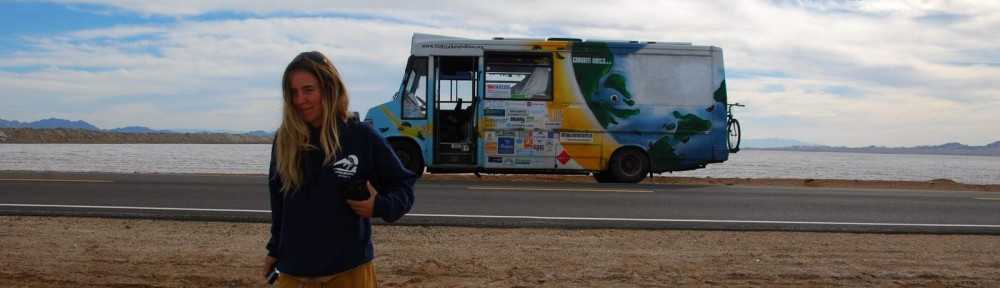
The Biotruck sold. I had two voices in my head. One saying “You can’t sell this truck, it’s your life’s work, your home, the embodiment of your ideals. It’s you”. The other voice, far more pragmatically was shouting, “Snatch the cash out of his hands before he changes his mind, you idiot!”. I took the money and watched the truck drive off, clutching on to the last whiffs of cooking oil exhaust as it disappeared over the horizon. For the next few days I kept glancing at the spot where it had been parked, half expecting it to have returned, like a lost dog that manages to sniff its way back to its owners. Instead I contented myself with a great pair of shoes and a broken laptop which came as part of the deal. Jan Carlo is closing down his shoeshop empire in order to wander the globe in a sustainable way. He was quite peeved at first that someone else had trumped him to the idea, but that emotion was soon outweighed by the fact the Biotruck was up for sale on Ebay. He came, slept the night in it, we spent a day haggling and then shook on it and the deal was done.
The journey for the truck will continue.
And the journey for Chris and I continues too. Tomorrow morning we start work in Biotruck IV. Yes. Four. The first one was the truck I drove to Mali using biodiesel made from waste chocolate. The second one was the one we drove to Athens, although this was a “rally” car really. And the third one is now in the hands of Jan Carlo.
The fourth one is parked outside now, loaded up with some old caravan windows, rolls of loft insulation, the solar panels from Biotruck III, a conical tank, lots of old hosing and more junk than I can begin to remember, let alone describe. For a while now I’ve been collecting junk and components that I’ll need to make the new truck, throwing them in the back, and tomorrow the time has come to start making sense of them all.
Firstly I have to fit the PV panels on the roof, just to get them out of the way so I don’t break them while I’m working on the rest of the truck. This requires drilling small holes in the roof which is a bit daunting. This is also tricky because at some point I want to fit roof hatches, a solar collector for hot water, and if there’s space left a roof garden/low profile greenhouse made out of more caravan windows. It’s a big roof, but there’s not really enough space for it all. Perhaps I can live with 360Watts of solar power instead of 480. With the money I could get for two of my six solar panels I might be able to afford an efficient fridge. After the panels, I’ll fit the windows. This requires cutting massive great holes in the side of the van, which is much more daunting.
This truck isn’t going to be all junk. Having learnt some lessons from the last one, I want to pick and chose what bits are recycled, and what parts are new and efficient. The truck itself for instance is only seven years old. It uses only eight litres to do 100km on motorways, less than half of the old Biotruck.
The engine is common rail, hence the better gas mileage, but converting it to run on used cooking oil is consequently a much tougher challenge. I need a fuel delivery pump that can pump cold vegetable oil at the right speed and pressure, and I am still undecided about how to configure the fuel system. Should I use a closed loop system or a traditional twin tank switching system? I spend the evenings sketching diagrams thinking about how I’d use the system, how to build it, and how it could go wrong.
But the engine conversion is still a way off. First I have to insulate the walls with the rolls of insulation made from recycled plastic bottles that YBS Insulation sent me, and finish the interior. The open-plan shower design worked well and I found an old glass fibre tray that needs repairing. The compost toilet was also great, although this time the vent will go out through the roof and I’m using one of Separett’s toilet seats instead of the whole toilet so I can shrink the size of the toilet and cubicle. Space is tighter in this truck. We still have Abaca’s amazing organic mattress but need to build the bed.
The kitchen and the table and chairs I can build with trash. On the drive down to Spain I stopped at Destruck, possibly France’s only caravan scrap yard. There I found the shower tray, the sink and stove unit. Destruck charge €450 to come and collect your caravan if you want to scrap it, then they spend a fair few man hours destroying it with a sledgehammer. They burn the wood, and recycle the aluminium chassis, the copper components, and the stainless steel. In practice they burn a lot of other unpleasant foams too. They were happy to sell me parts I need for not much money and handed me a sledgehammer of my own to remove the pieces I wanted. I came away after 3 hours with priceless window hinges I’d been searching for for days, and a stainless kitchen sink and stove. On the way back up through France I’ll be stopping off to get some roof hatches too.The stuff that’s not got recyclable they sell for pennies.
So this Biotruck represents a shift in philosophy of living purely off waste to a more compromised approach to allow for the benefits of the efficiency of newness. With the same find of cooking oil, I’ll be able to go twice as far, and I’ll be able to get there quicker.
Efficiency is supposedly able to deliver savings of 30% of our global carbon emissions (or more depending on whose figures you believe). And it can save us money too. Perfect, except it actually does the opposite. History has shown that efficiency actually leads to more consumption of energy. Take refrigeration for instance. Since the 1950s refrigeration has become progressively more efficient, and consequently cheaper. The result is that we use much more refrigeration than we used to. Cars now commonly have AC, domestic refrigeration capacity has become bigger, the dependency on cold-chain transportation is much more widespread. We now use much more energy keeping things cold than we ever did in the ’50s because it’s more cost efficient to do so.
Transportation has followed the same trend. Cars that are cheaper to run encourage more and longer journeys. Our sphere of community is spread over vast distances, because we can travel further with less fuel, but the result is we use more of the golden fossil nectar.
This is makes a myth out of the idea that Natural Gas is a carbon cutting solution, for vehicles or power generation.
Making fossil energy more expensive, so its price represents the damage it causes is the only way to encourage viable development of alternatives, and check consumption. But that’s hugely unpopular because it impacts dramatically on quality of life. No politician will do it, but eventually as the stuff runs out the price will climb anyway. It already is.
The fact that I’ll need to scavenge less fuel to travel as far may encourage me to travel more. But I’m not using fossil fuels, so instead of feeling guilty I can go back to smugly polishing my halo.